
Resource Centre
Research and guidance for managing contaminated environments
crcCARE’s Resource Centre provides access to technical guidance documents and research publications developed to support contamination assessment, risk management and remediation. Browse the collection below to explore resources used by environmental practitioners, regulators and researchers.
Accessing documents
The crcCARE Resource Centre provides secure, in-browser access to our collection of technical guidance documents. Choose a pay-as-you-go pack or an annual membership depending on how many documents you need.
All plans give you 12 months access to each document from the date you first open it. View the Terms & Conditions here.
50 documents found
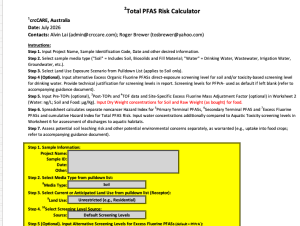
Technical Guidance 50 (Part 2): Risk-Based Investigation of Agricultural Fields and Food Crops Impacted by Contaminated Wastewater and Sludges (With PFAS Supplement)
This Excel sheet is the working file to support Technical Guidance 50 (Part 1): Risk-Based Investigation of Agricultural Fields and Food Crops Impacted by Contaminated Wastewater and Sludges (With PFAS Supplement).
🔒 Pay to accessMore Information
Technical Guidance 50 (Part 1): Risk-Based Investigation of Agricultural Fields and Food Crops Impacted by Contaminated Wastewater and Sludges (With PFAS Supplement)
This guidance builds and expands on site characterisation and risk assessment concepts presented in the crcCARE publication Risk-Based Investigation of Environmental Contamination (crcCARE 2026). The approaches described are applicable to both organic and inorganic contaminants. Methods for assessing the risk posed by heavy metals associated with wastewater and sludges are well established, and references are […]
🔒 Pay to accessMore Information
Technical Guidance 48 (Part 2): Risk-Based Investigation of Environmental Contamination
The guidance reflects the collective, twenty-plus year experience of a large group of local, national and international environmental experts trained in Gy’s Theory of Sampling. The guidance focuses on the use of “Decision Unit (DU)” and “Multi Increment® Sample” investigation methods for characterization of environmental media. (Multi Increment is a registered trademark of EnviroStat, Inc.). […]
🔒 Pay to accessMore Information
Technical Guidance 48 (Part 1): Risk-Based Investigation of Environmental Contamination
The two-part technical guidance document was originally developed and published by the HawaiÔi State Department of Health for use in site investigations, and was later adapted f….
🔒 Pay to accessMore Information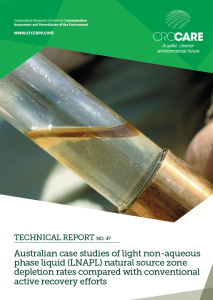
Technical Guidance 47: Australian case studies of light non-aqueous phase liquid (LNAPL) natural source zone depletion rates compared with conventional active recovery efforts
Natural rates of mass loss and biodegradation of light non-aqueous phase liquid (LNAPL) fuels and oils in soil and groundwater is termed natural source zone depletion (NSZD).
🔒 Pay to accessMore Information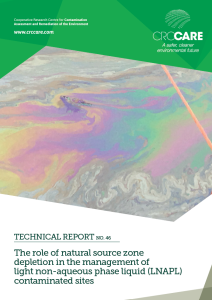
Technical Guidance 46: The role of natural source zone depletion in the management of light non-aqueous phase liquid contaminated sites
This report discusses a growing body of research showing that NSZD is ubiquitous at LNAPL sites. NSZD processes occur at all LNAPL sites to some degree and understanding, quantifying and evaluating their effectiveness is therefore an important part of a sustainable remedial strategy (CL:AIRE 2019). Accordingly, the potential significance of NSZD at Australian sites has […]
🔒 Pay to accessMore Information
Technical Guidance 45: Societal perceptions on remediation technologies guidance for engagement with residents
Remediation policies and guidelines are increasingly recognising the value of drawing on the knowledge and experiences of diverse stakeholders, including affected residents, to support technology selection, and to inform other related areas of remediation policy such as risk management and sustainability assessment. Despite policy support for these approaches, there is little understanding within the remediation […]
🔒 Pay to accessMore Information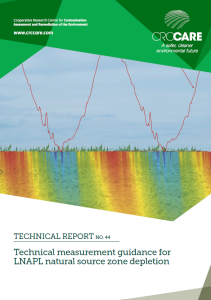
Technical Guidance 44: Technical measurement guidance for LNAPL natural source zone depletion
Natural source zone depletion (NSZD) is a term used to extend the traditional understanding of natural attenuation to the light non-aqueous phase liquid (LNAPL) source zone.
🔒 Pay to accessMore Information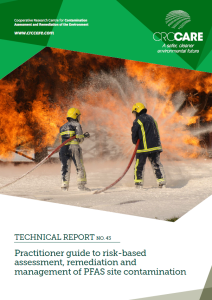
Technical Guidance 43: Practitioner guide to risk-based assessment, remediation and management of PFAS site contamination
This practitioner guide deals with PFOS and PFOA given their known physical and chemical properties, toxicity, and behaviour, fate and transport in the environment.
🔒 Pay to accessMore Information
Technical Guidance 42: A human health review of PFOS and PFOA
FOS and PFOA have been identified as contaminants of emerging concern in Australia. Both chemicals are persistent, bioaccumulative and potentially toxic, and exist at a number of sites, particularly where AFFF firefighting foams have been used. Originally, this report was developed to recommend tolerable daily intake (TDI) values for PFOS and PFOA, at a time […]
🔒 Pay to accessMore Information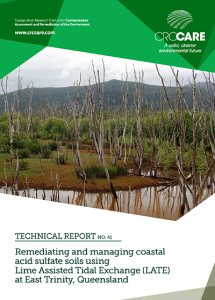
Technical Guidance 41: Remediating and managing coastal acid sulfate soils using Lime Assisted Tidal Exchange (LATE) at East Trinity, Queensland
This report reviews the implementation and associated research activities of a successful coastal acid sulfate soil (CASS) remediation strategy. East Trinity is a case study of how a severely degraded tidal wetland has been returned to a functional estuarine habitat using a cost-effective, low technology method based on the reintroduction of tidal water. The East […]
🔒 Pay to accessMore Information
Technical Guidance 40: Weathered Petroleum Hydrocarbons (Silica Gel Clean-up)
This technical report has been prepared to review the available information on the presence of polar metabolite compounds in samples collected from weathered petroleum hydrocarbon–impacted soil and groundwater. The aim is to identify an appropriate silica gel clean up (SGC) method for removing these compounds from the analysis of petroleum hydrocarbons, and to provide guidance […]
🔒 Pay to accessMore Information